Getting married after 60 means choosing a dress with a clear sense of what matters: feeling comfortable in it from morning to night. According to INSEE, 251,000 weddings were celebrated in France in 2025, with later-life unions contributing fully to this trend.
A wedding dress after 60 is about more than style. Comfort, mobility and practicality also come into play, and only a thorough fitting can confirm that the dress meets your needs.
Fittings and comfort: what your dress needs to prove before the big day
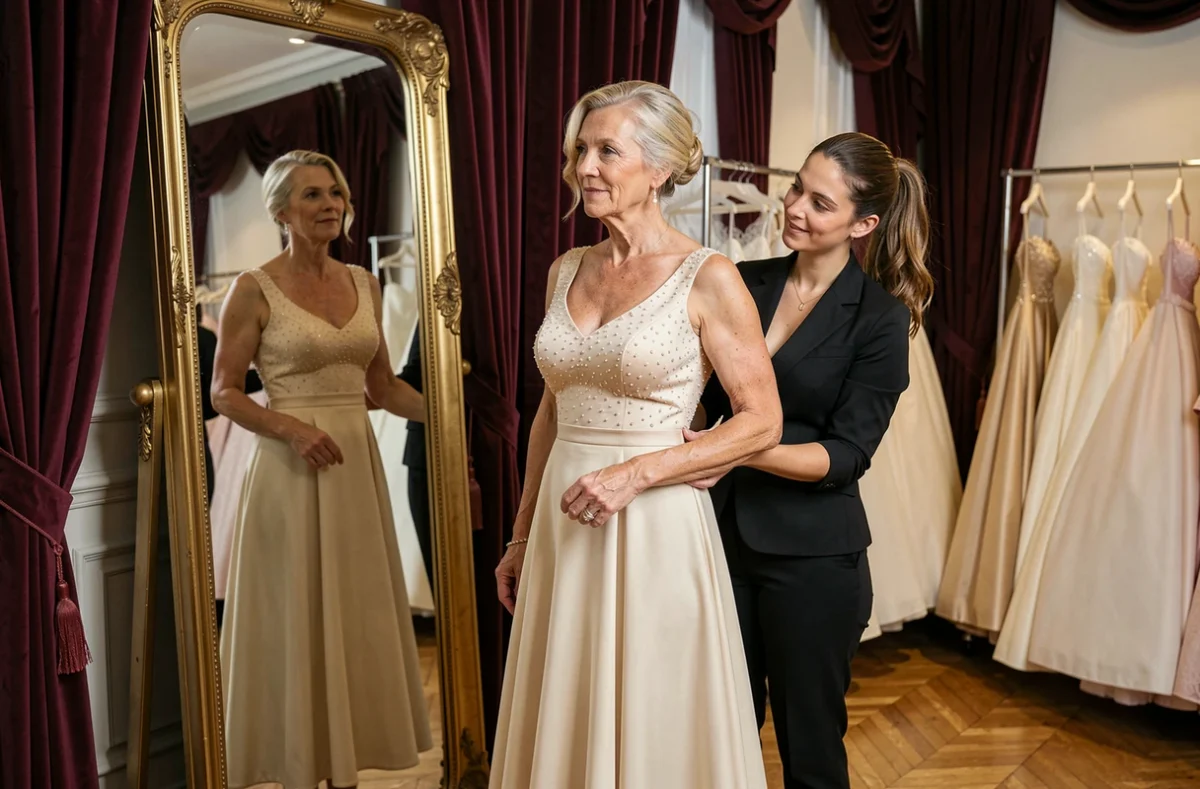
Have you ever worn a beautiful outfit that made it impossible to sit down or raise your arms? After 60, that kind of compromise is no longer acceptable. Your dress needs to pass a real-world test in the fitting room, not just look good in the mirror.
During your fitting, walk, sit down, climb a flight of stairs and bend over. These simple movements reveal whether the cut restricts your mobility. A closure you can manage without help is an important consideration, whether it’s a side zipper, concealed snap fasteners or a pull-on design.
Your shoes are part of the fitting too. A three-centimetre heel may seem reasonable in the shop but become uncomfortable after four hours at the reception. Bring the pair you plan to wear on your wedding day to check the hem and make sure you feel steady on your feet.
- Sit for several minutes to check for seams that dig in or a waistband that feels too stiff.
- Make sure the sleeves don’t restrict your arms when you hug someone or raise your glass.
- Check how breathable the fabric is: a synthetic lining can quickly become uncomfortable if the ceremony takes place in summer.
A 2026 feature by Sud Ouest describes the process offered by two professionals in Rochefort: the client chooses a design, requests alterations, then benefits from made-to-measure tailoring and last-minute adjustments. This kind of service makes it possible to fine-tune every practical detail, not just the look.
If you’re considering a short wedding dress at 60, trying it on while moving around is even more revealing: a midi or above-the-knee hem makes walking easier but shows more of your legs, which also affects your choice of tights or stockings.
Wedding dress fabrics and cuts suited to a mature figure
Crepe and stretch satin are among the fabrics best suited to mature figures. Their fluid drape follows the body without constricting it. By contrast, layers of tulle or stiff organza can add volume where you may not want it.
Lace works best as an overlay rather than as the main structure. Layered over an opaque fabric (crepe, mikado or supportive jersey), it adds texture without unwanted sheerness. If you choose it as the main fabric, it needs a well-made lining to avoid a “veil-like” effect.
Three flattering cuts and why they work
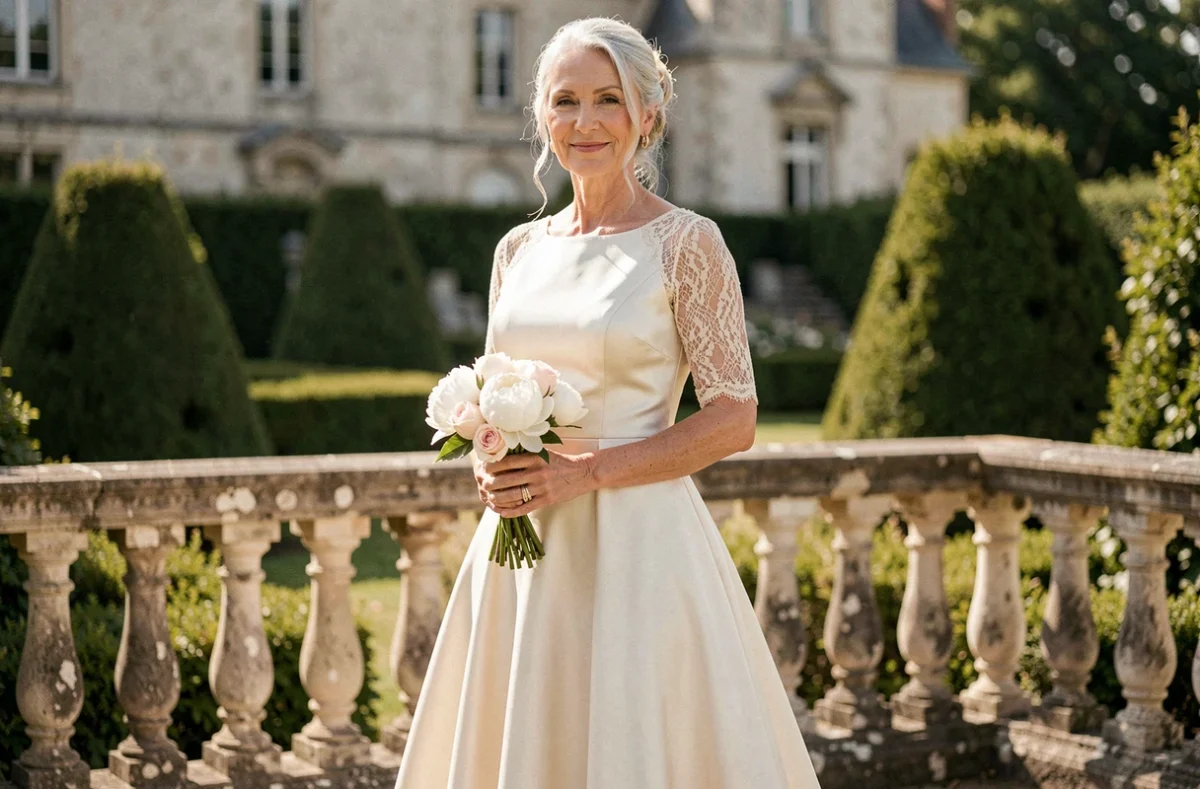
An A-line cut is fitted at the bodice and gently flares out. It doesn’t define the waist too sharply and skims over fuller hips. It’s the most versatile option for a ceremony followed by a long meal.
A straight or column cut elongates the figure, provided the fabric has a little stretch. Without any give, it can restrict movement and ride up when you sit down.
An empire cut, with a high waist just below the bust, leaves the stomach and hips completely free. It’s especially suitable when digestive comfort matters (as it often does at a wedding meal).
Suit, separates or dress: choosing an outfit to suit the wedding
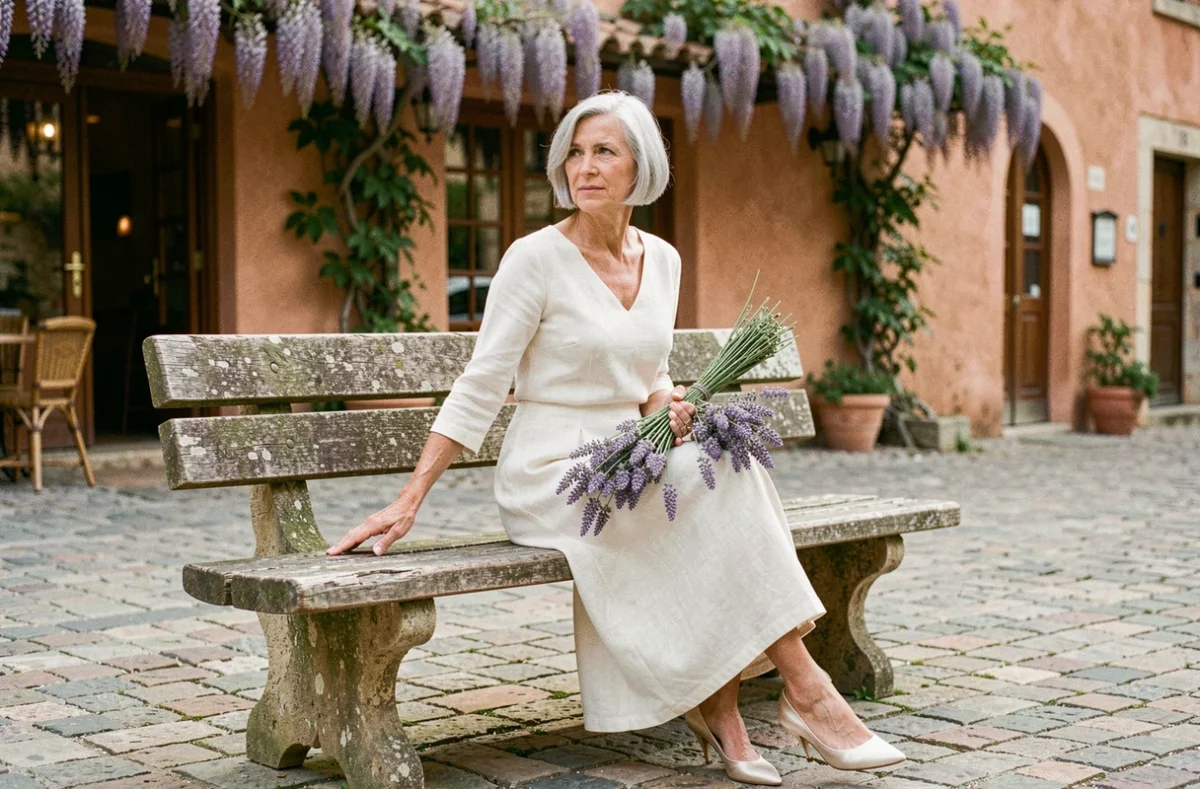
A long white dress isn’t the only option. An ivory crepe pantsuit is an elegant alternative for a civil ceremony or an intimate wedding. It allows complete freedom of movement and can be worn again for other occasions.
A midi skirt paired with a detailed top (a bateau neckline, three-quarter sleeves) gives you options: take off the jacket or wrap in the evening, and adapt your look to the temperature. Separating the top and bottom also makes alterations easier, since each piece can be fitted independently.
Your choice depends on the venue and the schedule. A religious ceremony followed by an outdoor cocktail reception calls for a different outfit than an intimate wedding at a restaurant. Why? Because your outfit needs to work for every part of the day, not just the photos.
Budget and alternatives for a wedding dress after 60
Made-to-measure doesn’t have to mean an unlimited budget. Independent dressmakers often start with an existing design and adapt it (sleeve length, neckline, closure). Made-to-measure means fitting the dress to your body, not the other way around.
Second-hand is another option, though it’s less common in this age group. According to the French Fashion Institute, second-hand clothing accounted for 11.8% of apparel purchases by value in the first half of 2025, but just 3.7% among people aged 55 and over. That doesn’t mean it’s a poor choice; it simply takes more searching to find a suitable design.
- Bridal boutiques with in-house alterations: one point of contact for choosing and fitting your dress.
- Local dressmakers who adapt existing patterns: complete control over every practical detail.
- Specialist bridal consignment shops: lower prices, but sizes and styles are available unpredictably.
Whichever option you choose, plan for at least two fittings with alterations. The first checks the overall fit; the second confirms the final adjustments. This timeline means starting your search at least three months before the wedding date.
A successful wedding dress after 60 is one you forget about during the celebration. If, by the end of the day, you’re thinking about the moments you shared rather than what you’re wearing, you made the right choice.