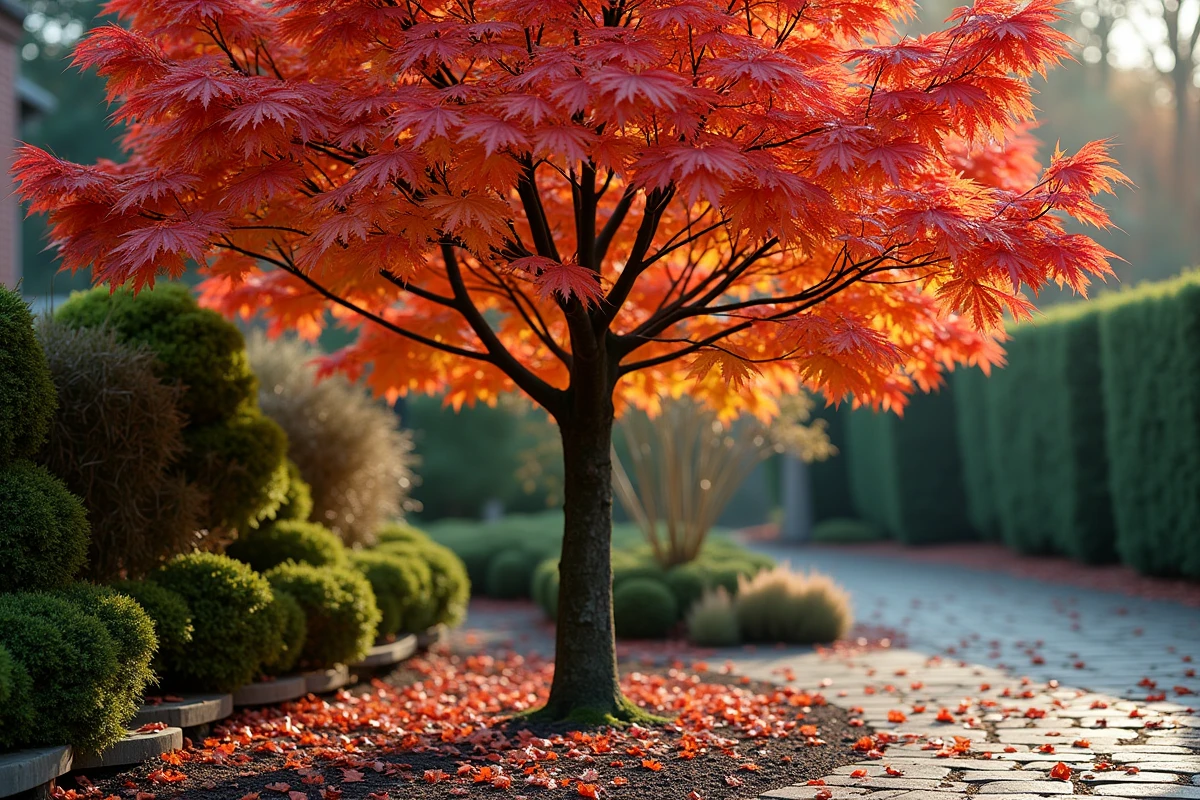
A Japanese maple planted full south that ends up bare in the middle of July, without prior yellowing: this scene repeats every summer in many French gardens. The leaf drop of the Japanese maple does not always follow the expected autumn cycle. Understanding what triggers it allows for action before the tree becomes exhausted.
Thermal stress and summer defoliation of Acer palmatum
It is often thought that a lack of watering causes a Japanese maple to lose its leaves in summer. The problem is sometimes more direct: the leaves are literally burned by the heat. Health bulletins published by the Fredon network (Île-de-France, Nouvelle-Aquitaine) have reported, since the heatwaves of 2019 to 2022, a marked increase in cases of leaf burn and early drop in well-watered Acer palmatum.
The correlation is strong with episodes where the temperature exceeds 35 °C, especially combined with dry winds. The finely dissected foliage of dissectum varieties (such as ‘Garnet’ or ‘Crimson Queen’) offers a large evaporation surface, which accelerates cellular dehydration. Dry necrosis is then observed on the tips and edges, followed by rapid leaf drop, without the usual autumn coloration.
Knowing when the Japanese maple loses its leaves normally helps distinguish a natural cycle from a warning signal. Autumn defoliation, with gradual coloration, is healthy. A sudden drop in June or July, with leaves still green, points to abiotic stress.
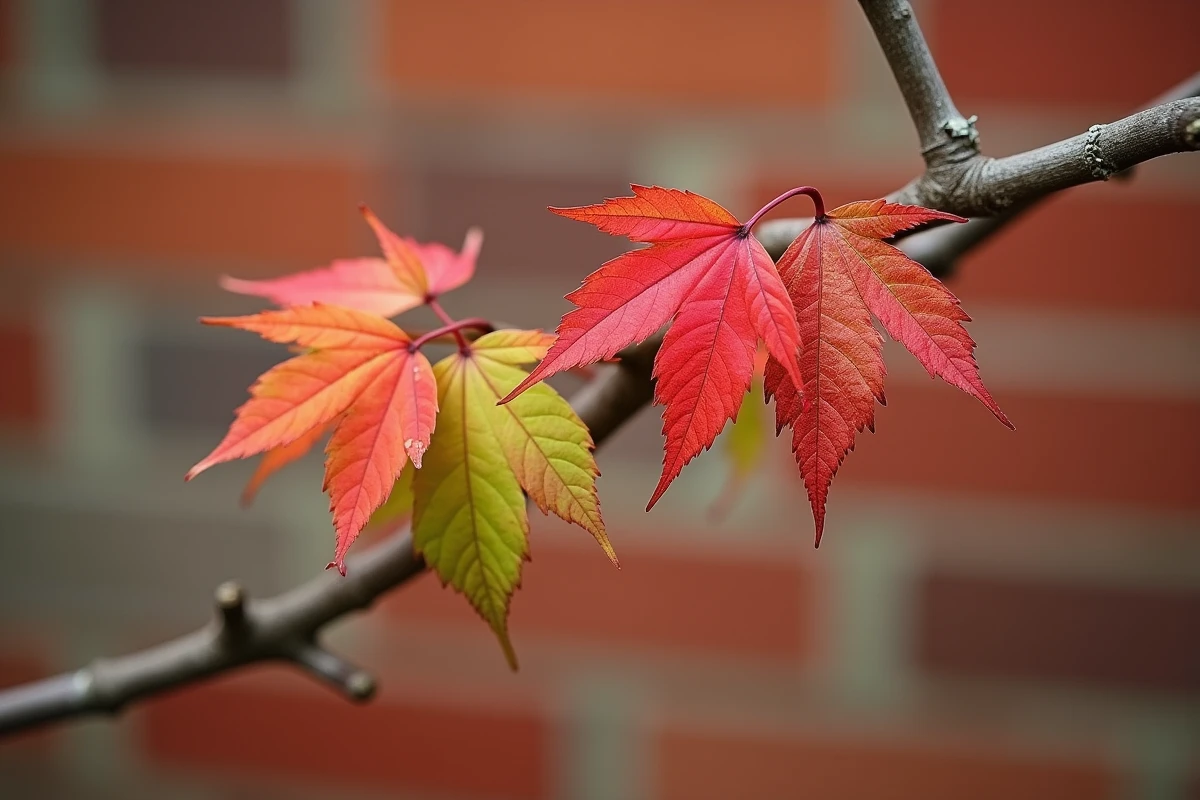
Soil, water, and de-icing salts: the underground causes
The soil plays a role that is often underestimated. An Acer palmatum planted in compact, clayey, and poorly drained soil will alternate between excess water in winter and severe drought in summer. This repeated water shock weakens the fine roots, those that absorb water and nutrients. The foliage reacts quickly: curling of the edges, browning, then drop.
Irregular watering in pots and in the ground
In pots, the problem worsens. The substrate dries out faster, especially in terracotta exposed to the sun. It is easy to go from generous watering to three days of forgetting. The Japanese maple does not handle these jolts well: regular and moderate watering protects better than occasional soaking.
In the ground, a thick mulch (pine bark, dead leaves, wood chips) limits evaporation and stabilizes soil temperature. The goal is to maintain cool soil but never waterlogged.
Urban pollution and road salts
Tree monitoring conducted by the City of Paris and Cerema has highlighted a phenomenon specific to Japanese maples planted in urban environments. Specimens located a few meters from salted roads in winter show marginal necrosis and early leaf drop. The accumulation of residual salinity in the soil, compaction, and air pollution creates a cocktail of stress that the tree translates into early defoliation.
If the maple is planted near a driveway or sidewalk that is regularly salted, one might consider a thorough rinsing of the soil in spring to dilute the accumulated salts.
Late frosts and wind: two enemies of spring foliage
The young leaves of Acer palmatum that unfold in April are particularly vulnerable. A late frost, even a light one (around -2 °C), is enough to cause blackening of the fresh shoots. The tree is not dead: it will often sprout again, but with delayed growth and less dense foliage for the rest of the season.
Desiccating wind poses a comparable problem. A Japanese maple situated in a windy corridor, without protection (wall, hedge, large trees), loses water through its leaves faster than it absorbs it through its roots. Reports on this vary by region, but gardens exposed to the mistral or east winds seem to be significantly more affected.
- Planting in partial shade, sheltered by a wall or under the canopy of a larger tree, reduces direct exposure to sun and wind.
- A frost cover placed on nights of late frost protects young shoots without suffocating the tree.
- Avoid full south exposures in regions where summer temperatures regularly exceed 30 °C.
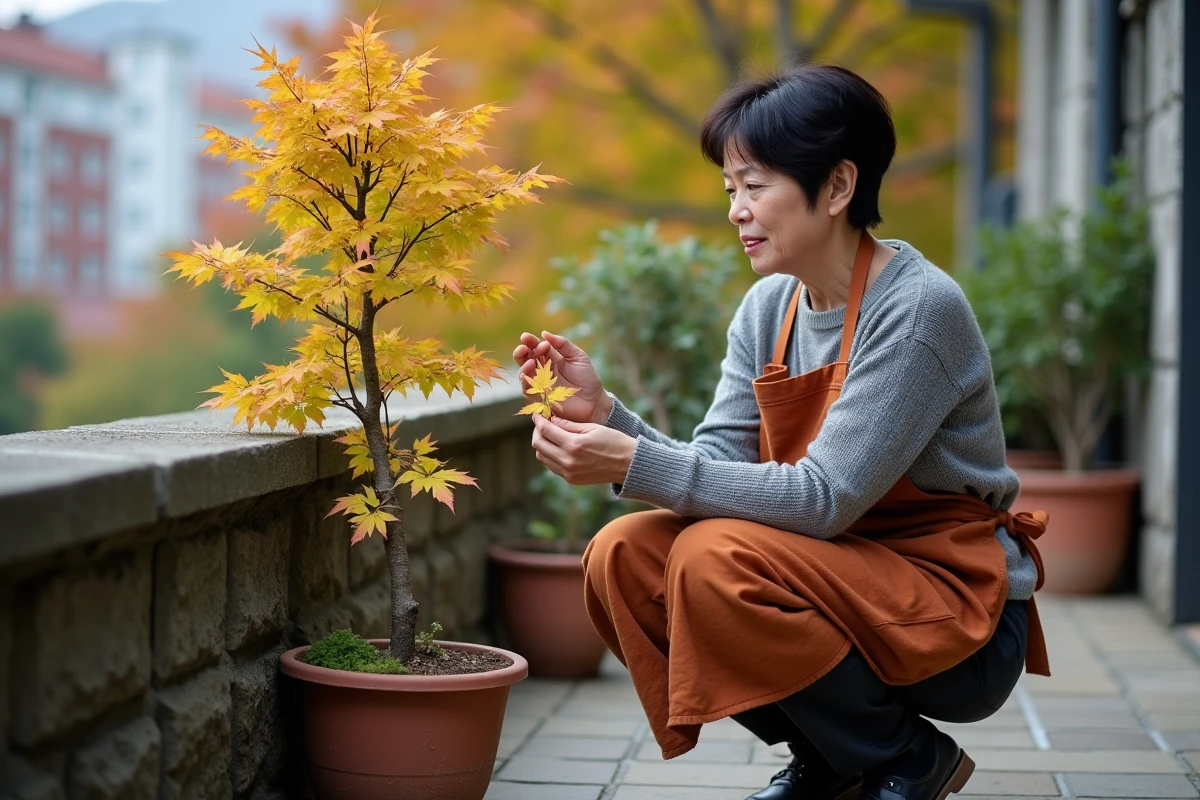
Verticillium wilt and fungal diseases: recognizing a pathological cause
Verticillium wilt (Verticillium dahliae) is the most common fungal disease in Japanese maples. The fungus, present in the soil, colonizes the sap-conducting vessels. Branches die one by one, often on one side of the tree. The foliage wilts and falls on the affected branches, while the rest of the crown appears normal.
To distinguish it from simple climatic stress, one can cut a suspicious branch at an angle: a brown or greenish discoloration of the vessels, visible under the bark, confirms vascular damage. There is no effective curative treatment. The only approach is to prune the affected branches (disinfecting the tool between each cut), improve soil drainage, and avoid replanting a maple in the same spot.
- Disinfect the pruner with 70° alcohol between each cut branch.
- Do not compost branches affected by verticillium wilt: burn them or dispose of them at a waste facility.
- Improve drainage before replanting if the soil is heavy and wet in winter.
Exposure and location: the choice that conditions everything else
Most problems with leaf drop in Japanese maples boil down to poor location. An Acer palmatum planted full south, in compact limestone soil, without wind protection, accumulates all the stress factors. Moving the tree (in autumn, when frost is not a concern) to a partially shaded location, in acidic to neutral, well-drained soil enriched with organic matter, often transforms the situation within one or two seasons.
For potted maples, the choice of container also matters. A sufficiently large pot, made of insulating material (wood, thick resin rather than fine terracotta), with a substrate composed of heather soil mixed with pumice, provides a thermal and moisture buffer that the foliage directly reflects in its health.
A Japanese maple that loses its leaves sends a clear message about its growing conditions. Correcting the exposure and soil resolves the majority of cases, long before considering treatment. The tree is resilient: placed in the right spot, it almost always bounces back.